

When I started working on my second album, I thought I had a sound and a process fairly figured out.
My first album, Regretfulnot, was the result of a year-long crash course in electronic music-making—MIDI controllers, virtual instruments, drum programming, sample selection, patch building, and layers of electronic effects processing. Though, crash course makes it seem more intentional and systematic than it was. More like a hodge podge of online courses, following YouTube tutorials, rabbit holes, and working for a short time with an unhelpful mentor and a long time (still!) with a helpful one.
I am pretty proud of learning all these tools that didn’t even exist the last time I released music (17 years ago, but who’s counting?). But the crux is that creating Regretfulnot came out primarily by accident while satisfying my newfound curiosity about electronic music and its production. I didn’t set out with a goal to make an album. That didn’t occur to me until I realized I had enough material and an idea for an album theme.
So naturally, to start album number two, I figured I’d use DAW project files from Regretfulnot as templates for my new tracks. That’s common guidance on music YouTube and online courses. I opened up some of the Bitwig project files, and either nothing struck me, or I was overwhelmed by all the elements that ended up going into the final track.
So I dropped that approach.
Then I challenged myself to spend at least two hours a day doing short brainstorming sessions to develop new melodies and drum patterns using the generative tools from Mixed In Key. It worked. Kinda. The melodies and patterns were certainly new ideas–and ones that I likely would never come up with myself. But they weren’t super inspiring and certainly not personal or meaningful. I felt like I was trying to squeeze creativity out of a computer instead of, you know, actually being creative.
My coach, Alex, preaches that creativity comes from using your body and tactile interaction with physical instruments or controllers, even when creating electronic music. Right. I lost track of that key bit of advice.
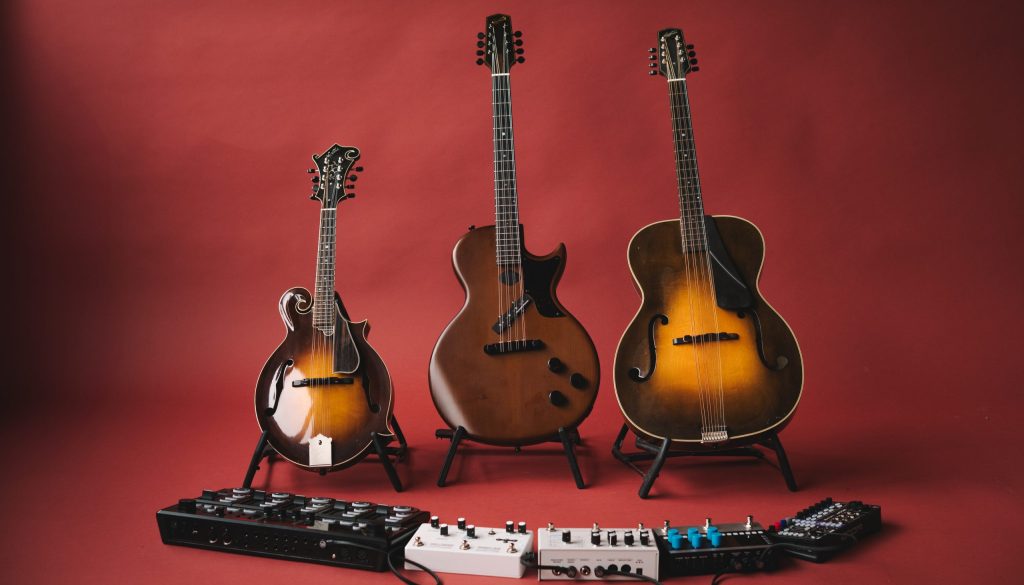
So, I came up with the idea of playing my mandolin—the instrument I’m best at and identify most with—through a bunch of new effects pedals to push forward my electro-acoustic explorations. I bought a couple of fancy pedals from Microcosm and a Boss looper station. These are some really cool and popular tools. I was excited.
Yup. The steep learning curve of multiple new tools curtailed my creativity. I bet you would’ve predicted that’d happen. Alex did in theory–from his instruction materials. But I didn’t tell him what I was about to do. That’s probably because I knew what he’d say! So, that means I knew myself.
After Alex saw my desk full of new gear, he suggested I eliminate all but one new thing. I actually sold all three of the pedals and, yeah, they are the pedals featured in my artist photos. I replaced those pedals with Loopy Pro. Yes, it’s new, but it’s so easy to learn; you’re up and running in minutes, a couple of weeks quicker than the Boss looper station. And Loopy Pro costs about $1,500 less than the pedals I sold.
I did buy a used APC-40 MkII to control Loopy Pro for $250. Alex suggested it because the native integration makes running the app almost completely tactile, translating to less friction and more emotion. But otherwise, the only new unfamiliar thing on my desk was Loopy Pro. (The other items were my audio interface and the Polyend Play+, so I can create drum patterns in seconds with its random pattern generator.)
Alright! I was pared down and ready to generate awesomely creative musical ideas.
I picked up my EleOcto electric octave mandolin from Northfield. I chose a random drum pattern on the Polyend Play+, pressed record (well, Loopy Pro is always listening), and just didn’t feel it. Why? I don’t know! But I was probably expecting to come up with something as cool as the EleOcto itself. I might have been missing my new crutch–er, creative tool–of electronic effects, which had sparked many ideas in Regretfulnot. So I put down the EleOcto in frustration and took a break.
I noticed my Guild Starfire bass guitar standing in the corner of my office. I bought the bass about five years ago, telling myself I would get back into playing bass after 25 years without one. I didn’t. I’ve only touched it in all seriousness once–to swap out a bass part in the track Lost Found Lost off of Regretfulnot.
Bass was my first instrument (well, after learning to sing). A guy in my WSU dorm taught me to play bass after asking me to join the Grateful Dead cover band he was forming. I don’t know what was more surprising: they had the patience for me to get passable at bass, having never played any melodic or chordal instrument, or the name we came up with for the band (Galactic Tofu Farmers!).
But back to the bass standing in the corner. I picked it up, remembering how I impulsively grabbed it when I realized the original Lost Found Lost bass part sucked and was blown away by what my fingers played with 25 years of rust. (Yeah, I have no problem saying it’s some good bass playing on that track.) The bass playing I recorded on Regretfulnot is better than I’d ever played before.
Like a few months before, my brain turned off, my body started moving, and my fingers produced some funky-ass bass line better than I’d ever played with previous bands.
I didn’t realize at the time that I was accidentally practicing shoshin, the concept of the beginner’s mind from Zen Buddhism. Practicing shoshin means approaching each moment with curiosity and openness but without assumptions. It’s not being purposefully naive or forgetting what you know. Instead, it’s letting go of what you think you know, so it doesn’t prevent you from truly experiencing what you’re doing.
Often, you can find the path forward right where you started if you can let go of what happened along the way. The 25-year bass playing gap and my musical development during that time allowed me to play openly and without preconceptions. Sometimes, getting creative requires getting back to bass-ics.
The bass is now my musical meditation cushion. (I actually meditate on top of throw pillows on a couch. I’m old! …and American.) Compared to the infinite options of digital production, the constraint of unadorned four strings and its deep bodily connection is liberating, not limiting. I generate a random drum pattern with the Polyend Play+ (turn a dial and press a button). I let it go with my bass. Then I’m in the right mind-state to lay down several creative ideas with my other instruments.
Let me tell you, the ideas that I’ve come up with are so much different than what’s on Regretfulnot. It’s probably a whole new sound. I will still bring in the digital effects, field recordings, and found sound. I’m just too fascinated by them. But those elements will be grounded by a deeper awareness and connection.
If you’re feeling stuck in your creative practice—music or anything else—maybe try bringing your awareness to whatever first made you excited about creating. Return to that. And begin again.